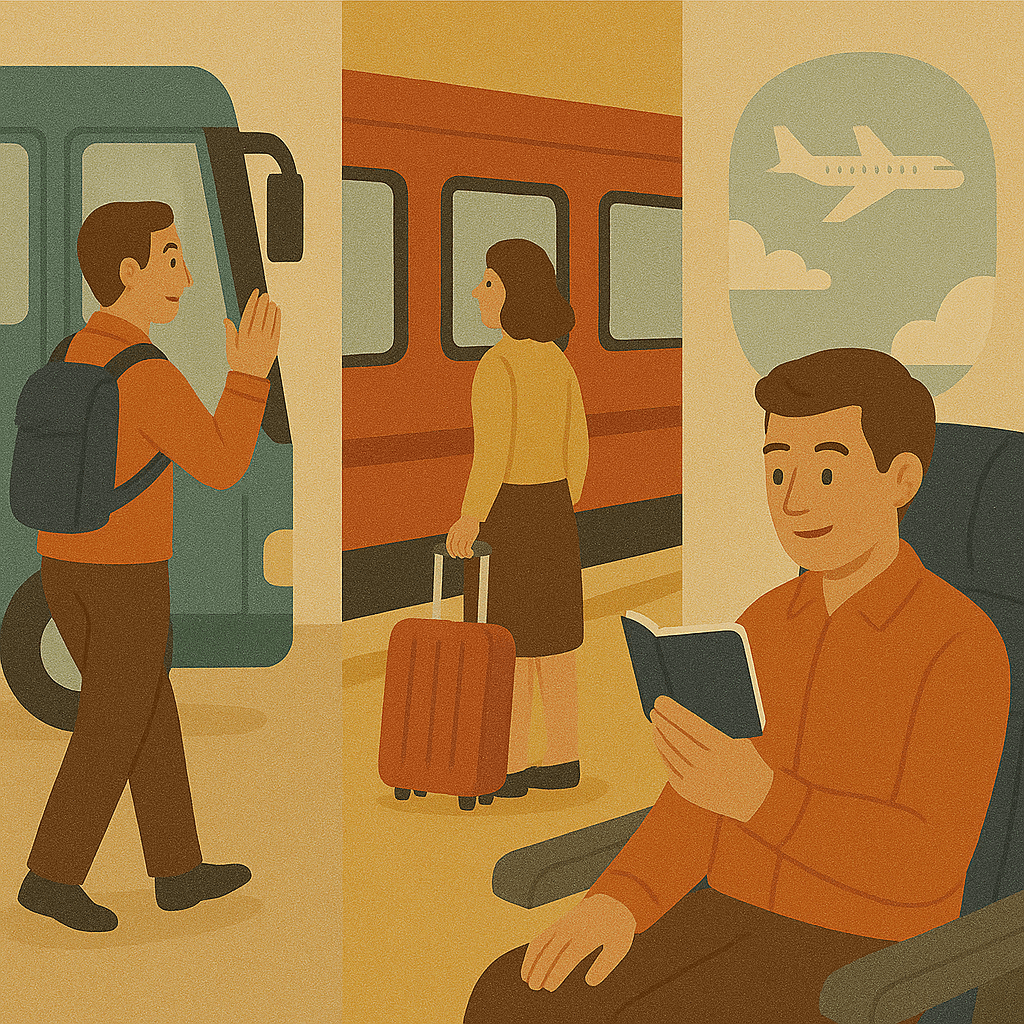
Frases útiles para viajar en español en autobús, tren o avión

🌎 Viajar en español con confianza

Saber algunas frases útiles para viajar en español puede cambiar completamente tu experiencia en un país hispanohablante. No solo podrás comprar boletos o pedir ayuda, sino también conectar con la gente local y disfrutar de una experiencia más auténtica.

In English: Knowing how to travel in Spanish helps you feel independent, confident, and culturally connected.
Auf Deutsch: Wenn du lernst, auf Spanisch zu reisen, fühlst du dich unabhängiger, sicherer und kulturell verbundener.

Viajar en español es también una forma de practicar el idioma en situaciones reales: en estaciones, aeropuertos o terminales. ¡Cada interacción es una mini clase práctica!


🚌 Viajar en autobús

Los autobuses son el medio de transporte más común en América Latina y España. Saber cómo comunicarte te permitirá moverte sin estrés. Aquí tienes frases clave:

  • “¿Dónde está la estación de autobuses?” → Where is the bus station?
  • “¿A qué hora sale el próximo bus a Quito?” → What time does the next bus to Quito leave?
  • “Un boleto a Santiago, por favor.” → One ticket to Santiago, please.
  • “¿Cuánto cuesta el pasaje?” → How much is the ticket?
  • “¿Este autobús va al centro?” → Does this bus go downtown?

💡 Tip in English:
In Latin America, people often say “bus,” “micro,” or “colectivo” — all mean “bus,” but each country has its favorite word. Learn the local term to sound more natural!

💡 Tipp auf Deutsch:
In Lateinamerika sagen die Menschen oft „bus“, „micro“ oder „colectivo“ – alle bedeuten „Bus“, aber jedes Land hat sein eigenes Lieblingswort. Lerne den regionalen Ausdruck, um natürlicher zu klingen!


🚆 Viajar en tren

En algunos países, como España, los trenes son una excelente opción para viajar cómodamente. Aprende estas expresiones:

  • “¿Dónde está la estación de tren?” → Where is the train station?
  • “Quisiera un billete de ida y vuelta.” → I’d like a round-trip ticket.
  • “¿Cuánto tarda el tren a Madrid?” → How long does the train to Madrid take?
  • “¿De qué andén sale?” → Which platform does it leave from?
  • “¿Es directo o con paradas?” → Is it direct or with stops?

💡 Tip in English:
The word “billete” (ticket) is common in Spain, while in Latin America, people say “boleto.” Both are correct, just regional variations.

💡 Tipp auf Deutsch:
Das Wort „billete“ wird in Spanien verwendet, während man in Lateinamerika „boleto“ sagt. Beide sind richtig – es sind nur regionale Unterschiede.


✈️ Viajar en avión

Viajar en avión puede parecer universal, pero cada país tiene su propio estilo de comunicación. Estas frases son esenciales:

  • “¿Dónde está el mostrador de LATAM?” → Where is the LATAM counter?
  • “¿A qué hora embarcamos?” → What time do we board?
  • “Mi vuelo está retrasado.” → My flight is delayed.
  • “¿Dónde recojo mi equipaje?” → Where do I pick up my luggage?
  • “Necesito cambiar mi vuelo.” → I need to change my flight.

💡 Tip in English:
Spanish airports often use the words embarque (boarding) and equipaje (luggage). Practice pronouncing them — they’re very common!

💡 Tipp auf Deutsch:
An spanischen Flughäfen hört man oft die Wörter embarque (Boarding) und equipaje (Gepäck). Übe ihre Aussprache – sie werden häufig verwendet!


🎧 En el aeropuerto, estación o terminal

Cuando necesites orientación o información, usa estas frases:

  • “¿Dónde está la puerta número cinco?” → Where is gate number five?
  • “¿Cuánto falta para llegar?” → How long until we arrive?
  • “¿Puedo dejar mi maleta aquí?” → Can I leave my suitcase here?
  • “¿Hay baños públicos?” → Are there public restrooms?

💡 Tip in English:
In Spanish-speaking countries, people often use gestures to give directions — don’t worry if they point instead of giving long explanations!

💡 Tipp auf Deutsch:
In spanischsprachigen Ländern benutzen die Menschen oft Gesten, um den Weg zu zeigen – keine Sorge, wenn sie zeigen, statt lange zu erklären!


🌍 Vocabulario esencial de transporte

EspañolInglésAlemán
El pasaje / el boletoTicketdas Ticket / die Fahrkarte
El asientoSeatder Sitzplatz
El horarioScheduleder Fahrplan
La maletaSuitcaseder Koffer
El retrasoDelaydie Verspätung
El embarqueBoardingdas Boarding / das Einsteigen
El equipajeLuggagedas Gepäck

🎯 Ejemplo de diálogo

👩‍🦰 Pasajera: Buenos días, ¿este tren va a Sevilla?
👨‍✈️ Empleado: Sí, señora, pero tiene que hacer un cambio en Córdoba.
👩‍🦰 Pasajera: Perfecto, ¿de qué andén sale?
👨‍✈️ Empleado: Del andén número 4. Sale en diez minutos.

💡 Tip in English:
Listen carefully to place names — many have accents on different syllables, like Cór-do-ba or Se-ví-lla. Pronouncing them well helps you sound natural.

💡 Tipp auf Deutsch:
Achte auf die Betonung der Städtenamen – viele haben Akzente auf unterschiedlichen Silben, wie Cór-do-ba oder Se-ví-lla. Eine gute Aussprache hilft, verstanden zu werden.


🧠 Mini Quiz

  1. ¿Qué significa “boleto de ida y vuelta”?
  2. ¿Qué palabra usan en España para “boleto”?
  3. ¿Cómo se dice “delayed flight” en español?

Respuestas:
1️⃣ Round-trip ticket
2️⃣ Billete
3️⃣ Vuelo retrasado


📚 Preguntas de comprensión lectora

¿Qué actitud cultural se valora al pedir información en un aeropuerto o estación?

¿Por qué es útil aprender frases de transporte antes de viajar?

¿Qué diferencias hay entre el español de España y América Latina en este contexto?

Scroll to Top